




















































































What Are the Specs, Pros & Cons of the Apple iPhone 16 Plus 2026?
What Makes the Apple iPhone 16 Plus One of Apple's Best Phones in 2026?
In Apple's 2024 lineup, the Apple iPhone 16 Plus occupies a unique position: it delivers a large screen and exceptional battery life at a price significantly lower than the Pro models — while retaining the modern A18 chip and all Apple Intelligence features. If you want a big-screen, long-battery phone without paying the full flagship price, the Apple iPhone 16 Plus deserves serious consideration. In this comprehensive guide, we break down everything about this device: specifications, display, camera, battery, design, software, and an honest analysis of its strengths and weaknesses — with a dedicated look at the Kuwait and Gulf market in 2026.
What Is the Apple iPhone 16 Plus and Who Is It Made For?
The Apple iPhone 16 Plus sits in second place in Apple's standard lineup — above the regular iPhone 16 thanks to its larger screen and bigger battery, and below the iPhone 16 Pro due to the absence of a Pro chip and triple-camera system. It's the ideal middle-ground choice for anyone who wants a large size and long battery life without needing to pay Pro model prices.
It suits those who prioritize long battery life above everything else, those who enjoy a large screen for content consumption and gaming, those who want full iOS with Apple Intelligence at a lower price than Pro, and anyone who regularly faces long days away from a charger.
For heavy users who spend long hours on their phones, the Apple iPhone 16 Plus offers something rare: a battery that exceeds 27 hours of video playback in a device that doesn't carry a Pro Max price. The heavy user who drains their battery before the end of the day will find a comprehensive solution to their biggest problem in this device.
If this is your first iPhone, the Apple iPhone 16 Plus delivers the complete iOS experience on a large screen that makes getting familiar with the system easier and more enjoyable. Apple Intelligence works at full capacity, and the guaranteed software support for years makes it a smart long-term investment.
Full Technical Specifications
Processor and Performance
The Apple iPhone 16 Plus runs on the Apple A18 chip built on 3-nanometer technology — the same chip found in the standard iPhone 16, not the A18 Pro exclusive to Pro models. It features 6 processing cores (2 performance + 4 efficiency), 5 graphics cores, and a 16-core Neural Engine with 8GB of RAM. In everyday use, you won't feel any noticeable difference between the A18 and A18 Pro in most tasks — both are fast, responsive, and capable of running any app with efficiency.
Storage comes in two options: 128GB for everyday general use, and 512GB for users who store large amounts of photos and video. There is no microSD slot, so it's recommended to choose carefully based on your storage habits.
Connectivity
The iPhone 16 Plus supports Wi-Fi 7 (802.11be) for faster wireless connectivity, 5G Sub-6GHz compatible with all networks in Kuwait, Saudi Arabia, the UAE, and Qatar, along with Bluetooth 5.3, NFC, UWB, and eSIM alongside the traditional SIM card.
One important weakness worth noting: the USB-C port operates at USB 2.0 speeds only (480 Mbps) — significantly slower compared to USB 3.2 in Pro models. Transferring large 4K video files via cable will take considerable time, and it doesn't support connecting external displays at high quality.
Display
The screen is a 6.7-inch Super Retina XDR OLED with a resolution of 2796 × 1290 pixels and a pixel density of 460 PPI. Brightness reaches 800 nits in typical use, 1,600 nits for HDR content, and 2,000 nits in direct outdoor sunlight — ensuring complete clarity under Kuwait's intense sun in even the most demanding environmental conditions in the region.
The display supports HDR10, Dolby Vision, and HLG, meaning Netflix, Apple TV+, and YouTube HDR content is displayed in its true colors and full detail exactly as its creators intended.
The refresh rate is a fixed 60Hz — the most frequently cited complaint about the iPhone 16 Plus. In 2026, most mid-range phones offer 90 or 120Hz. Scrolling is less smooth compared to Pro models, and this difference is noticeable to anyone who has experienced ProMotion before.
Dynamic Island at the top of the screen replaces the traditional notch. It houses Face ID and the front camera, and transforms and expands to display interactive information: music playback, kitchen timers, flight status, live sports scores — all without needing to open the app.
Camera System
The 48MP main camera with an f/1.6 aperture and advanced optical image stabilization delivers clear, detailed photos in most lighting conditions. Apple's Photonic Engine enhances every photo with AI to ensure natural colors and sharp details.
Thanks to the high-resolution sensor, the iPhone 16 Plus can crop the image to produce a 2× optical-equivalent zoom at full 12MP quality without any loss — effectively giving the user a free "second lens" without any technical complexity.
The 12MP ultrawide camera covers a 120-degree angle, ideal for landscapes, group shots, and architecture. It also supports Autofocus, enabling macro photography to capture fine details up close with remarkable clarity — a feature that was previously exclusive to Pro models in earlier generations.
For video, the device supports 4K at 60fps from both the rear and front cameras, Cinematic Mode at 4K/30fps, slow-motion at 240fps in 1080p, and Action Mode for fast-motion night recording. ProRes and Log Video are not supported — those remain exclusive to Pro models.
Battery and Charging
Apple estimates 27 hours of video playback — a noticeable improvement over the 15th generation. In real mixed daily use (calls, browsing, camera, video, social media), the Apple iPhone 16 Plus easily gets through a full day, with many moderate users reaching two days on a single charge.
Charging options include wired fast charging up to 25 watts (with a 30W or higher adapter, sold separately), reaching approximately 50% from zero in about 30 minutes with a suitable charger. MagSafe wireless charging at 25 watts transforms wireless charging from a slow experience into a genuinely practical option. The device also supports Qi2 at 15 watts and standard Qi at 7.5 watts. A MagSafe stand on your desk or in your car makes charging completely effortless.
Design and Build Quality
The iPhone 16 Plus design uses an aerospace-grade aluminum frame, a matte glass back that reduces fingerprints and provides a premium feel, third-generation Ceramic Shield on the front (the strongest in iPhone history), and straight edges for a modern look and secure grip.
Water resistance is rated at IP68 — 6 meters depth for 30 minutes — the same standard as the iPhone 16 Pro and Pro Max. Splashes, rain, and accidental spills won't damage the device under any circumstances.
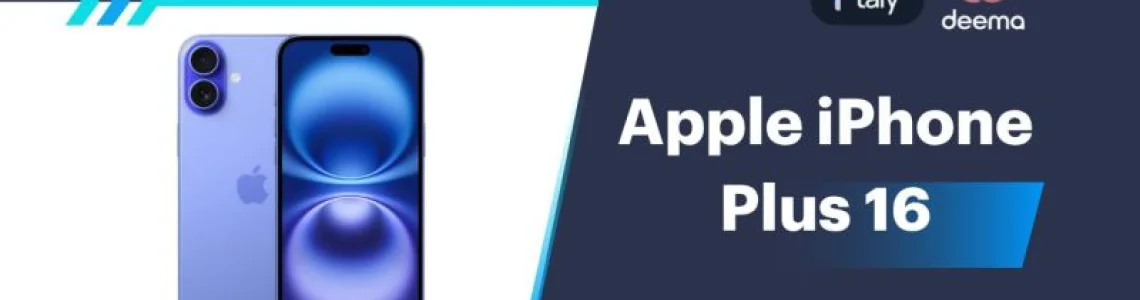
The device comes in five colors: Ultramarine, Teal, Pink, White, and Black.
Two New Buttons
The Camera Control button is a new side button that gives direct physical control over the camera: press to open it, swipe to adjust zoom, half-press for focus, full press to capture — all one-handed without touching the screen. For photographers who hold the phone in one hand and shoot with the same hand, this is a transformative change in how you take photos.
The Action Button is a fully customizable button that replaces the traditional mute switch. It can be set to: instantly open the camera, activate the flashlight, enable Focus mode, trigger a custom Shortcut, or any other function you choose from the settings menu.
Software and Apple Intelligence
The iPhone 16 Plus launched with iOS 18 and in 2026 runs iOS 19 with all its improvements. Apple's 5–7 year support commitment means the device will receive iOS updates until at least 2030–2031 — a long-term investment that makes it a genuinely economical choice over time.
Thanks to the A18 chip and 8GB of RAM, the device fully supports all Apple Intelligence features: writing tools for summarizing and rewriting text across all apps, Image Playground for AI image generation, enhanced Siri with contextual understanding and screen reading, smart notifications with automatic filtering and summarization, and Visual Intelligence for instant camera analysis. With iOS 19, Arabic language support for Apple Intelligence has expanded significantly.
Key Strengths
The battery is the primary strength of the Apple iPhone 16 Plus. If there is one reason to choose the Plus over the standard model, it's the battery. 27 hours of video playback in a device priced below the Pro Max — an equation with no direct competitor in Apple's lineup. For travelers and those working in environments far from power outlets, this device solves a real problem.
The 6.7-inch OLED display at 460 PPI and 2,000 nits makes content consumption on the iPhone 16 Plus an immersive experience. Dolby Vision HDR makes films look exactly as their directors intended. Social media, reading, and gaming — everything looks better on a larger, sharper screen.
For the Kuwait and Gulf markets specifically, the iPhone 16 Plus offers tangible advantages: a 27-hour battery that handles long travel days between airports and hotels, a 2,000-nit display that's clearly readable under the intense summer sun, 5G compatibility with Ooredoo, Zain, STC, and Viva, MagSafe 25W for fast charging in the car and office, Apple Intelligence with expanded Arabic support in iOS 19, IP68 durability that handles the region's extreme humidity and heat, and a lower price than Pro with the same chip and the same iOS experience.
Key Weaknesses
The 60Hz display on a 6.7-inch screen is the most repeated complaint about the Apple iPhone 16 Plus. In 2026, most mid-range phones offer 90 or 120Hz, making this the most obvious trade-off.
The camera system, while excellent, lacks a dedicated telephoto lens — zoom beyond 2× is digital and degrades in quality. There is no ProRes Video or Log Video, no full 48MP ProRAW, and the slow USB-C makes transferring large video files tedious.
When comparing to Pro models, the iPhone 16 Plus loses on refresh rate (60 vs 120Hz), camera system (two cameras vs three), and USB-C speed (2.0 vs 3.2). But it competes strongly on battery life (very close to the Pro Max) and price (significantly lower).
The choice between them comes down to one priority: if battery life and a large screen are most important to you, choose the Apple iPhone 16 Plus. If lighter weight and a lower price matter more, choose the standard iPhone 16.
FAQs
Yes. It runs iOS 19, fully supports Apple Intelligence, and carries the powerful A18 chip. For those who value battery life and a large screen, it remains a smart choice at a lower price than Pro.
Leave a Comment